


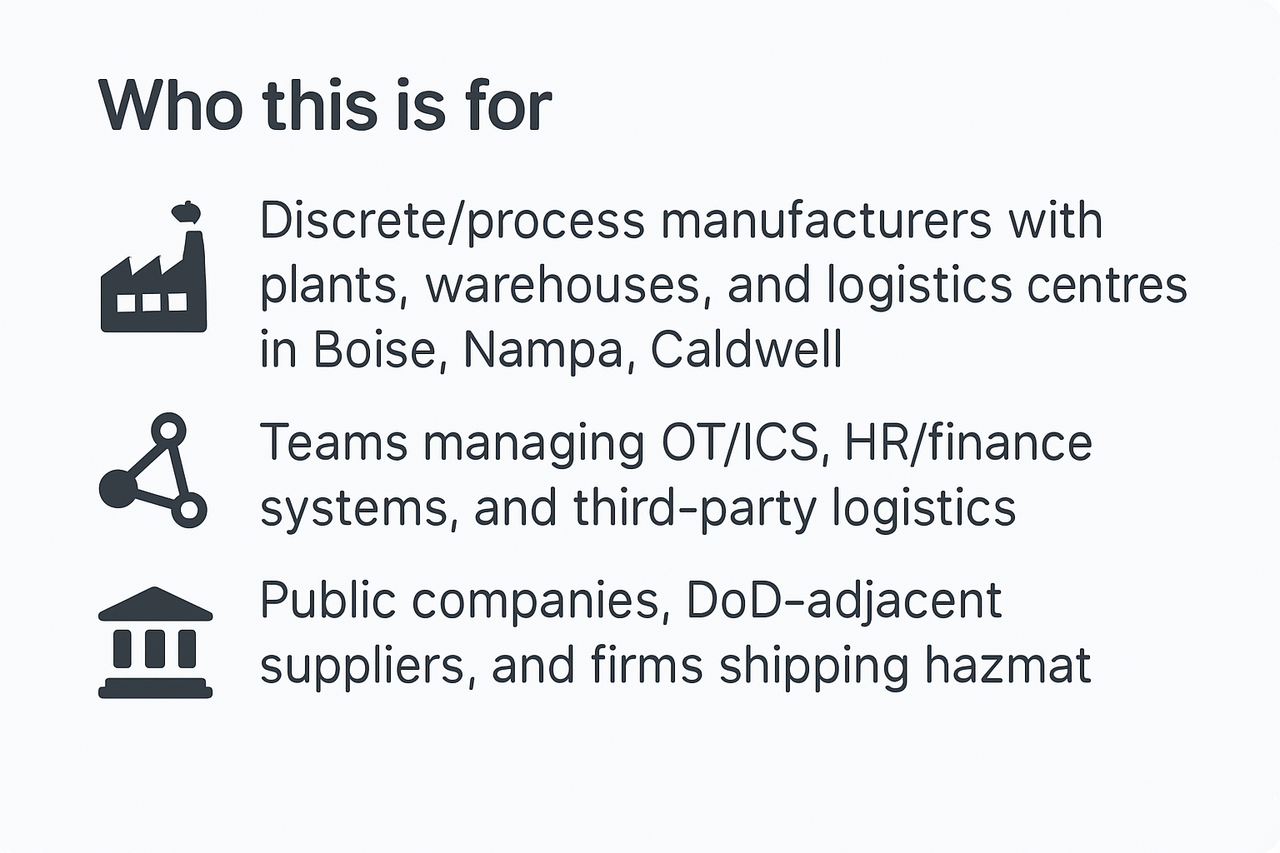
Running plants, warehouses, and logistics hubs across the Treasure Valley means juggling OT uptime, safety, and data risk. Idaho’s breach-notification law and federal rules (FTC/SEC/PHMSA/DFARS, plus multi-state privacy) all touch your operations. TotalCare IT builds a practical, site-ready infrastructure program that meets Idaho requirements and scales across locations.
What Idaho requires (and how we support it)
Breach notification
If unencrypted personal info about an Idaho resident is exposed and misuse has happened or is likely, the company must notify affected people without unreasonable delay.
MSP support: we handle the technical side—rapid containment, preserving logs, building timelines, and packaging incident evidence so your legal/compliance team can make the notification call and send notices.
What counts as “personal info”
A person’s name plus one of these (when not encrypted): Social Security number, driver’s license/ID number, or a bank/credit account number with a required code/password.
MSP support: we push encryption at rest/in transit, access controls, and monitoring—so if something does happen, you’re better protected and have the telemetry to assess harm.
Attorney General notice
Required for public agencies; not required for private businesses.
MSP support: we don’t advise on notifications, but we provide the artifacts (logs, indicators, impact summaries) your counsel needs to decide.
No broad Idaho privacy law (yet)
Idaho doesn’t have a California-style privacy statute. If you do business in other states, their privacy laws may still apply.
MSP support: we standardize identity, endpoint, secure access, MXDR/SIEM, backups, and basic data loss prevention controls so your environment aligns with common security expectations and produces the evidence your counsel/auditors request.
Why this matters operationally
Have a fast, repeatable response: a quick harm check (driven by good telemetry), a simple decision tree owned by your legal/compliance team, ready-to-send templates, and vendor terms that require prompt notice.
MSP support: we keep tools running quietly in the background, and schedule any impactful updates/changes during low-traffic windows (often overnight) with change control, pilots, and rollback—so protection improves without disrupting production.
Get the Manufacturer's Compliance checklist (PDF)
Federal & sector overlays you might hit
- FTC Act (reasonable security): Keep customer/employee data safe and don’t over-promise in privacy statements.
- FACTA Disposal Rule: Properly destroy background-check data (paper and electronic).
- SEC Cyber Rules (if public): Disclose material cyber incidents on Form 8-K within 4 business days of determining materiality; provide annual risk-management and governance details.
- CIRCIA (coming): Certain critical-infrastructure entities will have to report cyber incidents and ransomware payments to CISA on short timelines.
- DFARS / NIST SP 800-171 (DoD work): Protect CUI and report incidents within 72 hours to DoD; maintain evidence and a POA&M.
- PHMSA 49 CFR 172 Subpart I (hazmat): If you ship or handle covered hazardous materials, you need a written security plan and training.
- Export controls (EAR/ITAR): Sharing certain technical data—even with foreign nationals inside Idaho—can be a “deemed export.” Gate access and know what’s controlled.
How TotalCare IT helps (secure infrastructure that supports compliance)
Our role: We design, implement, and run the security infrastructure manufacturers need so operations align with common security expectations (NIST CSF/800-171, FTC “reasonable security,” SEC incident readiness, PHMSA security planning, and Idaho breach rules).
We don’t provide legal advice or certify compliance—we build and operate the controls that make compliance alignment achievable.
1) Secure Access Service Edge (SASE)
- Identity-first access with MFA and device checks for plants, warehouses, offices, and remote users
- Network segmentation to separate OT/ICS from IT and restrict lateral movement
- Web/DNS security and egress policies to reduce phishing and command-and-control risk
- Consistent policies across all your sites, whether they are Boise, Nampa, Caldwell, or even out-of-state sites
2) Endpoint Security (EDR + hardening)
- Managed EDR on endpoints and servers with manufacturing-aware policies (HMI/engineering workstation safe configs)
- Application and removable-media controls with governed exceptions
- Disk encryption and hardened images to speed clean rebuilds
3) MXDR (Managed eXtended Detection & Response)
- 24×7 monitoring, triage, and rapid containment (isolate host, block indicators, kill processes)
- Threat hunting tuned to ransomware and OT-adjacent attack paths
- Clear incident documentation your auditors/customers can consume
4) SIEM & log retention
- Centralized log collection and correlation (firewalls, identity, servers, endpoints, cloud)
- Alert tuning to cut noise and focus on material risk
- Retention and export sized for investigations and audits
5) GRC enablement (controls & evidence, not legal)
- Control mapping from deployed tech (SASE/EDR/MXDR/SIEM) to frameworks like NIST CSF/800-171
- Evidence-ready artifacts: asset lists, coverage reports, patch metrics, backup tests, network diagrams, IR runbooks
- Risk/exception tracking surfaced to your compliance/legal team for decisions
6) Backup, recovery, and ransomware resilience
- 3-2-1 strategy with immutability/offline options and scheduled restore tests
- Email & collaboration protections (spoofing/phishing controls) to reduce human-layer
Idaho breach readiness (the tech side)
- Fast containment and telemetry to support harm analysis and notification decisions
- Forensics-friendly logging and incident timelines packaged for your legal/compliance advisors
What you’ll get in the first 30–90 days
- A standardized security stack across sites (SASE, EDR, MXDR, SIEM) with policy baselines
- Asset & network map (IT + OT) with prioritized hardening actions
- IR runbooks (isolate, contain, restore) and a recent restore test report
- Evidence (coverage, logs, backup tests, patch SLAs) your compliance/legal team can use


